Apology Letter Tips: How to Write Apologies
Last updated on 13 March, 2026

Roma KończakEditor & Writer, Certified Professional Résumé Writers and Career Coaches (PARWCC)

Our customers have been hired by*:
What is an apology letter?
An apology letter expresses your regret for making a mistake in a business or personal situation. An honest apology letter works best when it’s sent promptly and says what you’re apologizing for straight away. Your message should show you take full responsibility without making excuses. You can also suggest action to correct your mistake or prevent future incidents.
Elements of an apology letter
- Opening: Clearly say the purpose of your apology message
- Acknowledgment: Admit the mistake and its impact on the person or business
- Responsibility: Take full responsibility for your actions without giving excuses or blaming others
- Action plan: Outline your plan to fix the problem and prevent similar mistakes in the future
- Closing: Summarise the message, repeat you’re sorry, and express regret; you may also ask for forgiveness if you feel it’s appropriate
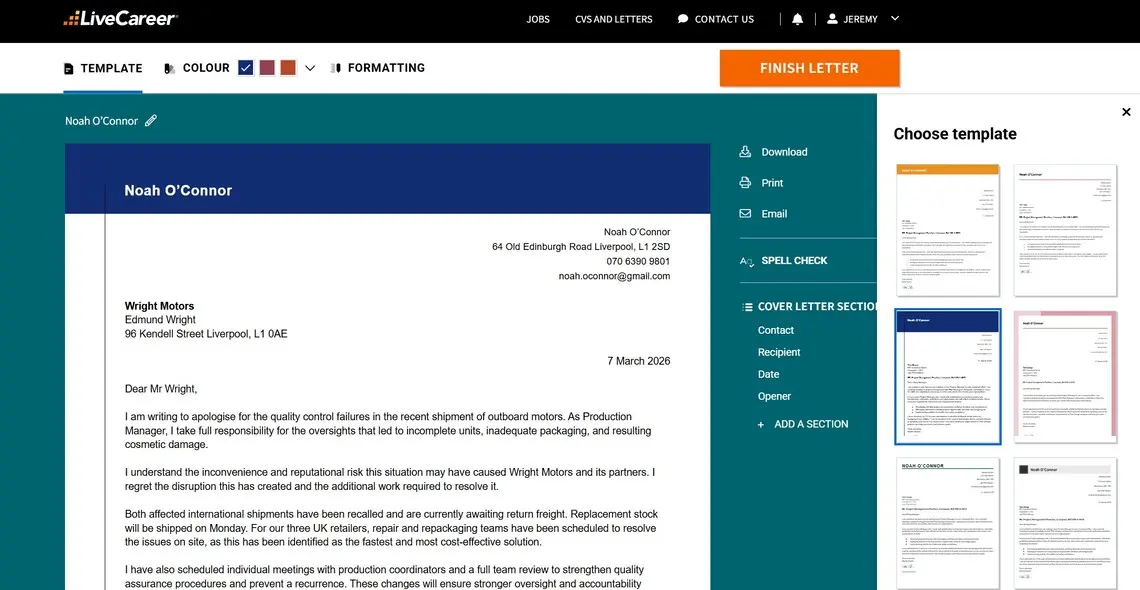
Make your apology letter look professional with LiveCareer UK cover letter builder. It’s a great tool for creating all kinds of business letters with just a few clicks.
Apology letter examples
General apology letter template
Example
Dear [Name],
I want to sincerely apologise for [specific incident] on [date].
I know that my actions caused [e.g., problem, financial loss, frustration], and I take full responsibility for my mistake. I understand that there is no excuse for what happened, and I’m truly sorry that I let you down.
I sincerely want to correct my mistake, and that’s why I have [actions you’ve taken to fix your mistake]. I also want to [actions to prevent recurrence] to ensure this does not happen again.
Thank you for your understanding.
Sincerely,
[Name]
Business apology letter example
Example
Noah O’Connor
64 Old Edinburgh Road
Liverpool, L1 2SD
070 6390 9801
noah.oconnor@gmail.com
7 March 2026
Edmund Wright
Owner
Wright Motors
96 Kendell Street
Liverpool, L1 0AE
Dear Mr Wright,
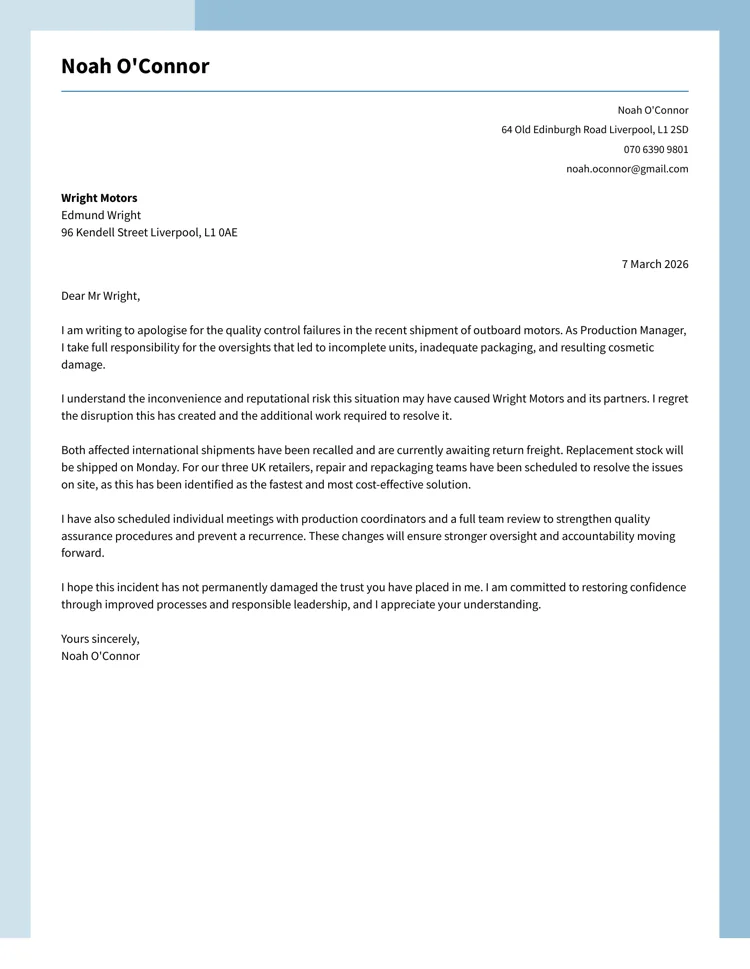
I am writing to apologise for the quality control failures in the recent shipment of outboard motors. As Production Manager, I take full responsibility for the oversights that led to incomplete units, inadequate packaging, and resulting cosmetic damage.
I understand the inconvenience and reputational risk this situation may have caused Wright Motors and its partners. I regret the disruption this has created and the additional work required to resolve it.
Both affected international shipments have been recalled and are currently awaiting return freight. Replacement stock will be shipped on Monday. For our three UK retailers, repair and repackaging teams have been scheduled to resolve the issues on site, as this has been identified as the fastest and most cost-effective solution.
I have also scheduled individual meetings with production coordinators and a full team review to strengthen quality assurance procedures and prevent a recurrence. These changes will ensure stronger oversight and accountability moving forward.
I hope this incident has not permanently damaged the trust you have placed in me. I am committed to restoring confidence through improved processes and responsible leadership, and I appreciate your understanding.
Yours sincerely,
Noah O’Connor
Tips for writing your apology letter
An effective apology message focuses on the impact of your actions on the recipient. Here are a few tips to help you prepare your written apologies:
- Write your apology message as soon as possible
- Say you’re sorry
- Keep it simple, specific, and straight to the point
- Don’t defend or explain yourself
- Show that you understand the mistake you’ve made
- Say what actions you’ll take to prevent similar problems
- Write in a tone that’s appropriate for the setting – business or personal
- Proofread your letter of apology to check grammar and spelling
To help you express your apologies, you can use these action words:
- Acknowledge
- Admit
- Apologize
- Compensate
- Forgive
- Intend
- Mistake
- Misunderstand
- Neglect
- Offend
- Rectify
- Regret
- Reimburse
- Repair
- Repay
- Sorry
- Violate
- Wrong
Expert advice: Research shows that apologies are more effective when the person admitting to a mistake focuses on taking responsibility for their actions and promises to repair the resulting damage.
How to write an apology letter step-by-step
Follow the steps below to write a good apology message that works in various settings, whether you need an apology letter for a mistake at work or you want to send an apology letter to someone you hurt.
Step 1: Outline your letter of apologies
You don’t want the recipient of your apology message to throw it away after a quick glance – that’s why the right structure matters.
Your apology letter for him, her, or a business associate must include:
- Proper greeting that depends on your relationship
- Letter opening stating you want to apologise
- Admitting you’ve made a mistake or caused a problem
- Your intent to take responsibility for the issue
- Plan to fix the problem or prevent similar issues
- Letter closing, thanking them for their understanding
Step 2: Say you’re sorry right away
No matter if it’s a short apology letter for work or a heart-touching apology message for your loved one, there’s no space for fluff in written apologies. Cut to the chase. Say you’re sorry in the letter opening.
Do it this way:
- Acknowledge what went wrong without minimising it
- Take responsibility for your actions, even if others were involved
- Show that you understand how your actions affected the recipient
Step 3: Show you want to make amends
Making mistakes can lead to personal growth, but only if you’re willing to change. Show you want to fix the problem you’ve created.
For example, an apology letter to a customer for a mistake can say:
We intend to fix the mistake we’ve made by reimbursing the full cost of the product.
And here’s an example from an apology letter to a girlfriend:
I really want to solve this problem. From now on, I will take time to plan my chores each week to make sure you don’t feel overwhelmed.
Here are a few tips to help you:
- Say what you have already done to address the issue
- Explain what steps you are currently taking to fix the problem
- Keep solutions realistic and specific
Remember: improvement matters, excuses don’t.
Step 4: End your written apology effectively
Reiterate your apology and show you’re ready to move forward.
Here’s what you can do:
- Repeat you’re sorry
- Ask for forgiveness (if you feel it’s needed)
- Use a formal sign-off in a business apology letter
Step 5: Proofread your apology
The tone of your message depends on the situation:
- Heart-touching apology message to a friend should be warm and direct
- Apology letter from a business to a customer should use formal language
- In an apology letter for a mistake at work, the tone should match the company culture
Here are a few tips:
- Use a formal tone for clients, executives, and unfamiliar recipients
- Avoid over-emotional or overly casual phrasing
- Match the tone to the relationship and seriousness of the situation
Step 6: Format the letter professionally
How your apology message looks affects its overall tone – presentation should support your words. That’s important especially when you want to send this apology letter by mail.
Here’s how to format your letter of apology:
- Keep paragraphs short
- Use standard business letter fonts
- Align the text to the left side
- Limit length to one page maximum
- Add your brand logo at the top if it’s a business letter
When your apology letter looks right, your message will sound better.
If you want to write a different business letter, check these articles:
- Acceptance Letter Sample
- Appeal Letter Sample
- Appointment Letter Sample
- Appreciation Letter Sample
- Leave Letter Sample
- Termination Letter Sample
- Recommendation Letter Sample
- Reference Letter Sample
- Resignation Letter Sample
- Retirement Letter Sample
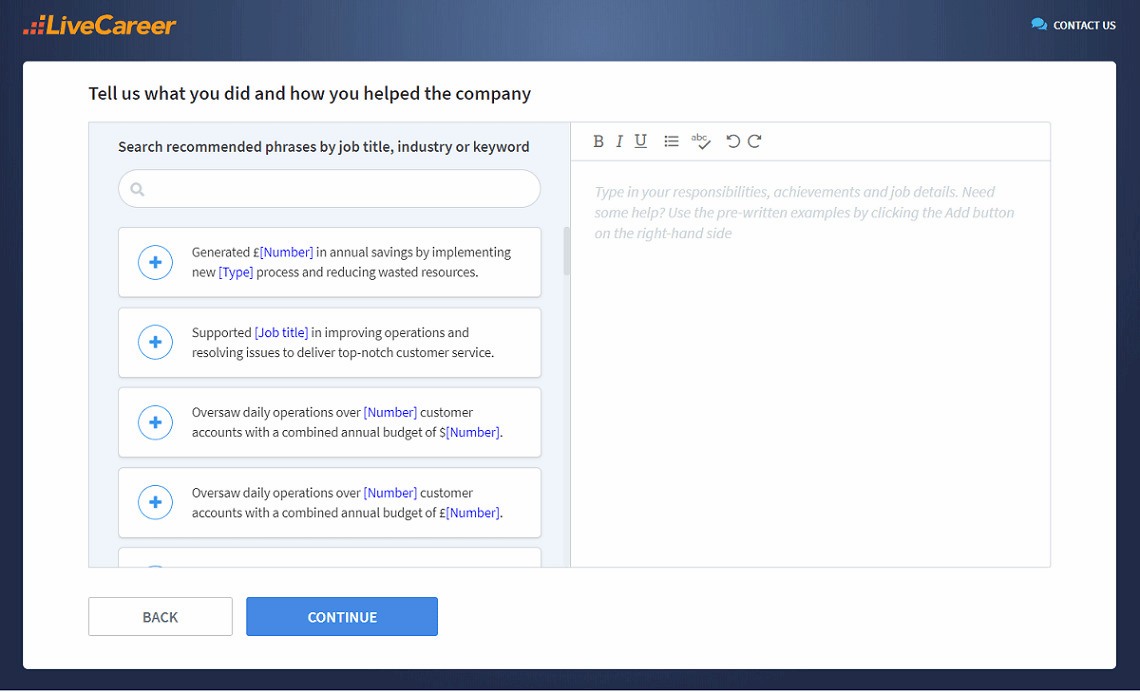
You don’t have to be a CV writing expert. In the LiveCareer CV builder you’ll find ready-made content for every industry and position, which you can then add with a single click.
Frequently asked questions about apology letters
When should I write an apology letter?
You should write an apology letter when you’ve made a serious mistake in a professional context. For example, you’ve missed deadline, sent the wrong product to the customer, or didn’t deliver promised results. Apology letters are especially important when you can’t apologise in person. In personal life, a short apology message instead of a letter is usually fine.
What is the best apology message?
A good apology message is short and direct. It says you’re sorry and that you’re willing to fix the mistake you’ve made. For example:
I’m sorry I forgot about your football match. I know how important it was to you, and I should’ve remembered. I will always put events important to you in my timetable so I don’t forget about them in the future.
What does a heartfelt apology letter look like?
Here’s an example of a heartfelt apology letter:
I’m really sorry for what I’ve done. I know my behaviour hurt you, and I’m fully aware of the disappointment I’ve caused. I regret my actions, and I want to ensure that nothing like that happens in the future.
How we review the content at LiveCareer
Our editorial team has reviewed this article for compliance with LiveCareer’s editorial guidelines. It’s to ensure that our expert advice and recommendations are consistent across all our career guides and align with current CV and cover letter writing standards and trends. We’re trusted by over 10 million job seekers, supporting them on their way to finding their dream job. Each article is preceded by research and scrutiny to ensure our content responds to current market trends and demand.
Sources
- Shuhong Gao, Jinzhe Yan, “Verbal or Written? The Impact of Apology on the Repair of Trust: Based on Competence- vs. Integrity-Based Trust Violation”
- Zhenxian Piao, Ngoc Tran Nguyen, Hyoung Ju Song, Jeong-Yeol Park, “Beyond I am sorry: Investigating the impacts of apology type and language style on customer forgiveness in service recovery”
About the author
Roma Kończak
Roma Kończak is a Certified Professional Résumé Writer and career specialist with a background in education and the humanities. Since joining the team in 2022, Roma has focused on producing thoroughly researched articles offering practical advice on CV writing and career development.
Looking for a job-winning CV?
Crafting a job-winning CV is all about showcasing your unique skills and experiences. Start with a strong personal statement that highlights your career goals and achievements.
Try Our CV Builder Now