Archaeologist CV Example & Guide
Last updated on 5 February, 2026

LiveCareer UK Editorial TeamLiveCareer UK Career Experts
Our customers have been hired by*:
As an archaeologist, crafting a compelling CV is essential to showcasing your expertise and passion for uncovering the secrets of the past. Highlighting your qualifications, such as fieldwork experience, research skills, and knowledge of archaeological methodologies, can set you apart in this competitive field. Our expert advice on writing an archaeology CV will guide you in effectively presenting your skills and achievements, complete with tailored examples to enhance your application.
Create an effective CV in minutes. Choose a professional CV template and fill in every section of your CV in a flash using ready-made content and expert tips.
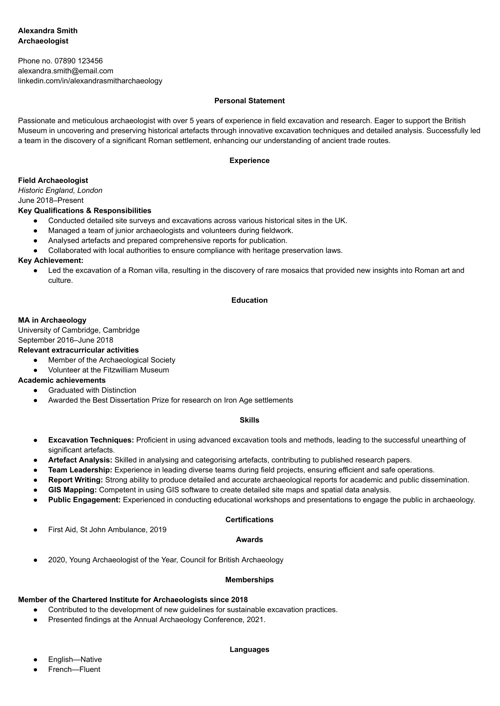
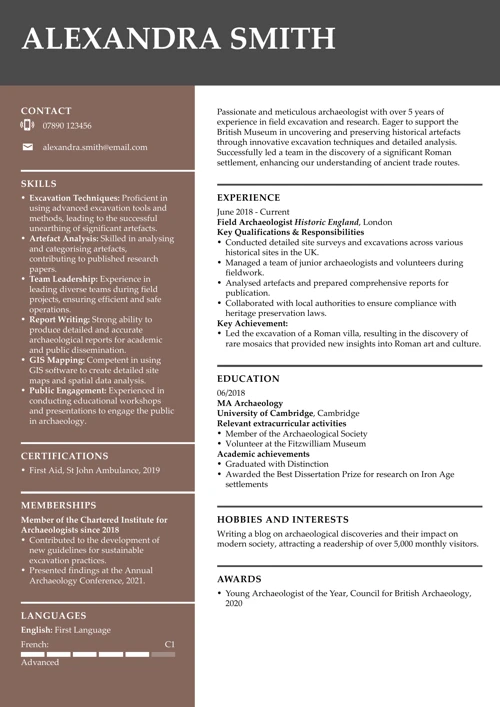
We created the sample on the left using our builder. See other good CV examples like this one.
Save a lot of time—just copy this archaeologist CV template and use our tips to adjust it to your needs:
Archaeologist CV example
Example
Alexandra Smith
Archaeologist
Phone no. 07890 123456
alexandra.smith@email.com
linkedin.com/in/alexandrasmitharchaeology
Personal Statement
Passionate and meticulous archaeologist with over 5 years of experience in field excavation and research. Eager to support the British Museum in uncovering and preserving historical artefacts through innovative excavation techniques and detailed analysis. Successfully led a team in the discovery of a significant Roman settlement, enhancing our understanding of ancient trade routes.
Experience
Field Archaeologist
Historic England, London
June 2018–Present
Key Qualifications & Responsibilities
- Conducted detailed site surveys and excavations across various historical sites in the UK.
- Managed a team of junior archaeologists and volunteers during fieldwork.
- Analysed artefacts and prepared comprehensive reports for publication.
- Collaborated with local authorities to ensure compliance with heritage preservation laws.
Key Achievement:
- Led the excavation of a Roman villa, resulting in the discovery of rare mosaics that provided new insights into Roman art and culture.
Education
MA in Archaeology
University of Cambridge, Cambridge
September 2016–June 2018
Relevant extracurricular activities
- Member of the Archaeological Society
- Volunteer at the Fitzwilliam Museum
Academic achievements
- Graduated with Distinction
- Awarded the Best Dissertation Prize for research on Iron Age settlements
Skills
- Excavation Techniques: Proficient in using advanced excavation tools and methods, leading to the successful unearthing of significant artefacts.
- Artefact Analysis: Skilled in analysing and categorising artefacts, contributing to published research papers.
- Team Leadership: Experience in leading diverse teams during field projects, ensuring efficient and safe operations.
- Report Writing: Strong ability to produce detailed and accurate archaeological reports for academic and public dissemination.
- GIS Mapping: Competent in using GIS software to create detailed site maps and spatial data analysis.
- Public Engagement: Experienced in conducting educational workshops and presentations to engage the public in archaeology.
Certifications
- First Aid, St John Ambulance, 2019
Awards
- 2020, Young Archaeologist of the Year, Council for British Archaeology
Memberships
Member of the Chartered Institute for Archaeologists since 2018
- Contributed to the development of new guidelines for sustainable excavation practices.
- Presented findings at the Annual Archaeology Conference, 2021.
Languages
- English—Native
- French—Fluent
Interests
- Writing a blog on archaeological discoveries and their impact on modern society, attracting a readership of over 5,000 monthly visitors
A well-crafted archaeologist CV can set you apart by demonstrating relevant experiences and skills. Starting with a compelling personal statement, this CV for archaeologist roles adopts a tailored strategy, demonstrating how your strengths can benefit the organisation. It also showcases a notable achievement in archaeology early on, even before delving into work history. By adopting this method, your archaeologist CV will distinguish itself, capturing the attention of hiring managers.
5 Tips for writing an archaeologist CV
To excel in crafting an archaeologist CV, consider these five insightful tips tailored to the profession:
- Emphasise Fieldwork Experience: Showcase your hands-on experience in archaeological digs and excavations, detailing the sites and techniques employed.
- Highlight Research Skills: Illustrate your ability to conduct thorough research, analyse findings, and contribute to academic publications.
- Demonstrate Methodological Knowledge: Detail your familiarity with archaeological methodologies and technologies, such as GIS or radiocarbon dating.
- Showcase Project Management Abilities: Highlight any experience in managing archaeological projects, including budget oversight and team leadership.
- Incorporate Relevant Soft Skills: Include essential skills such as communication, teamwork, and problem-solving, vital for collaborative fieldwork.
By following these suggestions, you’ll craft an archaeologist CV that captures the interest of potential employers. If you’re unfamiliar with CV writing, consider brushing up on the fundamentals of CV creation.
Here’s a quick writing guide to help you prepare an archaeologist CV:
How to write an archaeologist CV that beats competitors
In the competitive field of archaeology, your CV needs to stand out. Crafting a general CV that you can easily customise for each application is a smart strategy. Avoid a generic approach, as a personalised application is key to success.
The tips below will help you target your archaeologist CV to a specific role, so you can make as many variations of your application as you need:
1. Structure the archaeologist CV template properly
The structure of your CV is crucial, much like the precise layers of an archaeological site. Ensure your CV is organised with sections in the following order: header, personal statement, work history, education, skills, and additional sections. Arrange your experiences in reverse chronological order. If you’re crafting a CV without prior experience, consider swapping the order of education and work history.
Career experts recommend using simple CV templates that are favoured by recruiters and applicant tracking systems. Your archaeologist CV should prioritise clarity over fancy visuals, maintaining proper formatting. Set margins to 1 inch on all sides, with 1–1.15 line spacing to ensure readability. Opt for classic fonts like Times New Roman or Calibri, using font sizes of 11–12 for text and 13–14 for headings. Once your CV is complete, save it as a PDF, unless otherwise specified by the application system.
2. Present relevant archaeologist achievements in your personal statement
Your personal statement serves as a promotional tool, showcasing your suitability for the role you are targeting. A strong introduction to a CV for archaeologist positions effectively highlights your professional accomplishments and relevant expertise. Capture the attention of the hiring manager by aligning your personal statement with the job requirements, ensuring it reflects your unique strengths and experiences. Aim for a concise introduction of 3–4 sentences.
A strong CV summary will convince the recruiter you’re the perfect candidate. Save time and choose a ready-made personal statement written by career experts and adjust it to your needs in the LiveCareer CV builder.
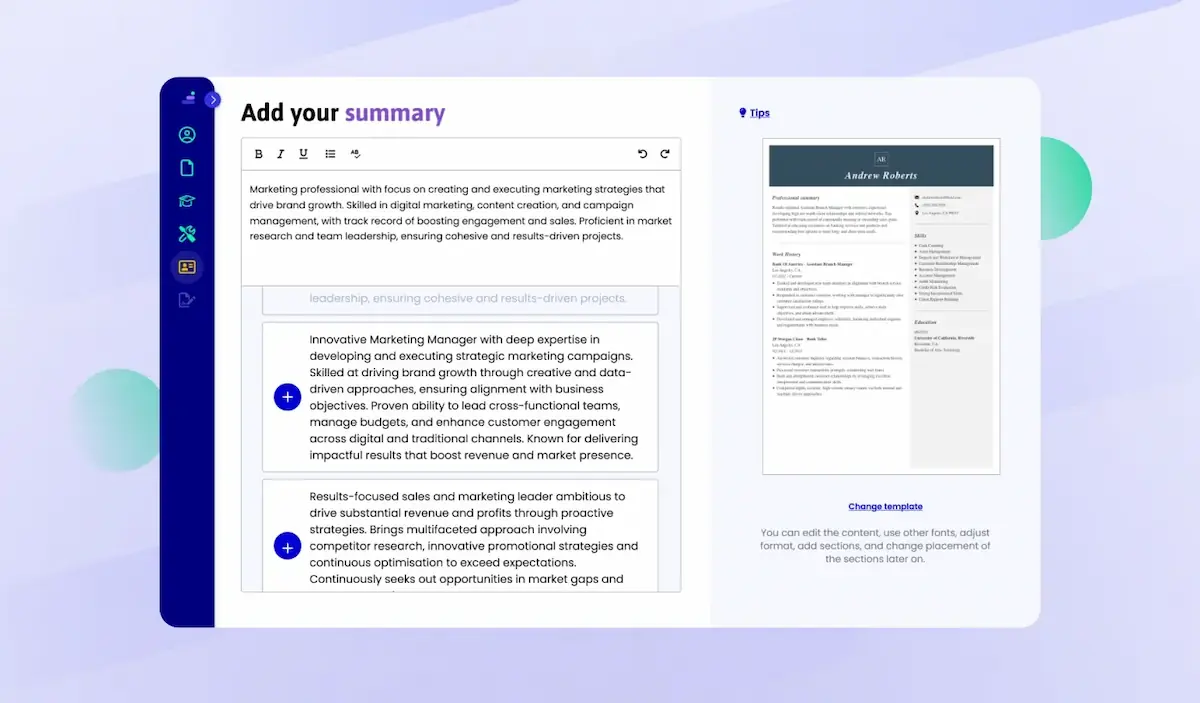
3. Describe past duties that match your desired role
In the field of archaeology, it is essential to show employers you can fulfil the role’s responsibilities effectively. The work experience section of your CV should detail your capability in conducting excavations, analysing artefacts, and collaborating with multidisciplinary teams. Include 3–5 bullet points highlighting your competence in these areas, along with a key achievement that stands out. Each bullet point should begin with a compelling action verb for a CV to make a strong impact.
Even without direct archaeological roles, you may possess relevant experience from academic projects or volunteer work. Consider developing a skills-based CV to prioritise your pertinent skills at the forefront of your application.
We’ve prepared a list of exemplary professional achievements for an archaeologist CV to inspire you:
Professional duties & achievements for an archaeologist CV—examples
- Conducted detailed site surveys and excavations, ensuring accurate recording and preservation of findings.
- Utilised GIS technology to map and analyse archaeological sites with precision.
- Authored research papers contributing to the understanding of prehistoric cultures.
- Managed excavation teams, coordinating tasks and ensuring compliance with safety regulations.
- Secured funding for projects through successful grant applications and proposals.
- Developed educational outreach programmes to engage the public with archaeological findings.
- Led workshops and seminars on archaeological methods for students and professionals.
- Analysed artefacts and ecofacts to determine historical significance and context.
- Collaborated with historians and geologists to reconstruct historical landscapes.
- Presented findings at international conferences, enhancing the institution’s reputation.
4. Show educational background on your archaeology CV
For those beginning their career in archaeology, your educational background can be a significant asset. Although entry-level roles may not always demand extensive academic credentials, possessing a degree in archaeology or a related field can significantly enhance your prospects for advancement. It’s crucial to prioritise your most advanced qualifications first, listing them in reverse chronological order. Make sure the education section of your CV includes pertinent coursework and any extracurricular activities that demonstrate your abilities. Explore tips on writing your degree on a CV and consider showcasing extracurricular activities that highlight relevant skills.
5. List the key skills for an archaeologist CV
There’s a good and a bad way to present skills on an archaeologist CV, much like the difference between a well-curated exhibition and a jumbled display. A less effective method involves simply listing skills without context or connection. Conversely, a superior approach involves customising your skills list to reflect the job description and adding descriptions that illustrate your professional mindset.
Core competencies for an archaeologist combine both soft skills and hard skills,such as communication, time management, critical thinking, field survey techniques, and proficiency in archaeological software. Carefully review the job posting to ensure you have highlighted all the skills relevant to the position you seek.
6. Enhance your archaeologist CV with optional sections
Additional CV sections aren’t just fillers, so use them wisely. They can serve as opportunities to demonstrate your qualifications for the role.
Your choice isn’t limited to professional certificates or licences. As an example, knowledge of foreign languages can be highly useful for participation in international archaeological projects. Plus, industry knowledge demonstrated in the hobbies and interests section can help your archaeology CV win additional points.
7. Write a cover letter to improve your chances
An application remains incomplete without a cover letter that provides deeper insights beyond the CV. Tailor your cover letter by articulating your sincere enthusiasm for the role. Begin with a personal introduction, segue into your skills and experiences, and end the letter by highlighting how your contributions would benefit the organisation. Suggest a follow-up meeting or call and conclude with a professional sign-off.
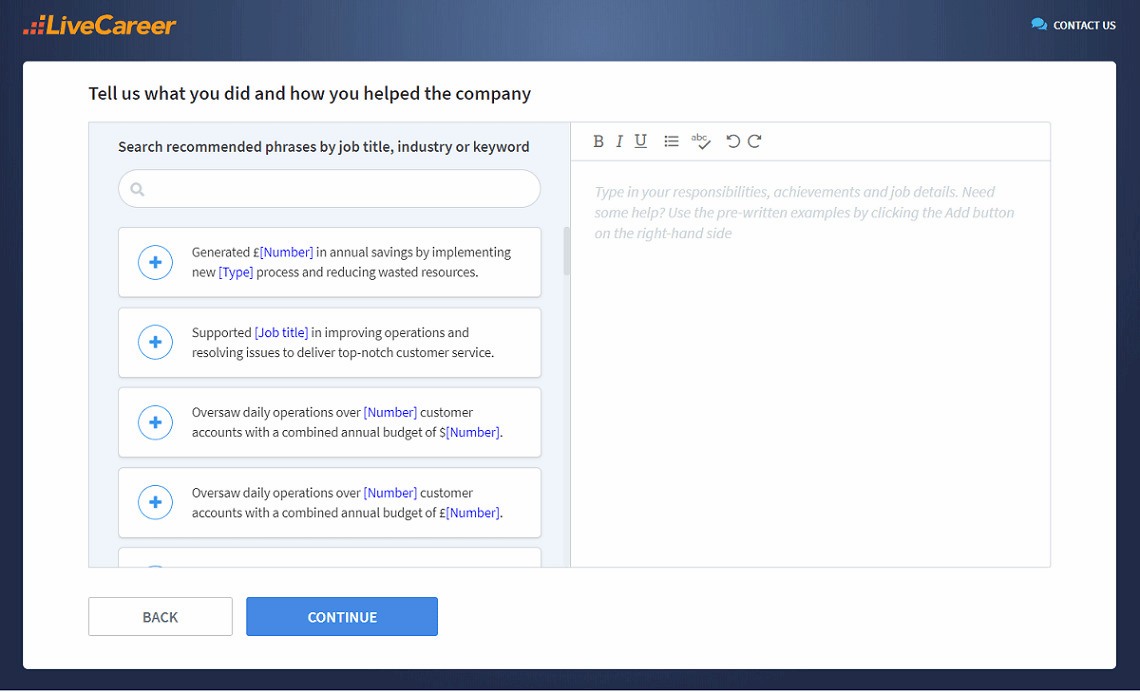
You don’t have to be a CV writing expert. In the LiveCareer CV builder you’ll find ready-made content for every industry and position, which you can then add with a single click.
Applying for other jobs? Try these CV examples as well:
In the journey of your archaeological career, every application is a step towards uncovering new opportunities. Thank you for reading, and feel free to leave any questions about creating an archaeologist CV in the comments below.
How we review the content at LiveCareer
Our editorial team has reviewed this article for compliance with LiveCareer’s editorial guidelines. It’s to ensure that our expert advice and recommendations are consistent across all our career guides and align with current CV and cover letter writing standards and trends. We’re trusted by over 10 million job seekers, supporting them on their way to finding their dream job. Each article is preceded by research and scrutiny to ensure our content responds to current market trends and demand.
Sources
About the author
LiveCareer UK Editorial Team
LiveCareer UK CV builder is powered by career experts, CV writers, and HR professionals. Since 2013, our editorial team has supported job seekers with free, research-based career advice and expert tips to improve their job applications. LiveCareer UK CV builder has already helped thousands, and you can be next.
Looking for a job-winning CV?
Crafting a job-winning CV is all about showcasing your unique skills and experiences. Start with a strong personal statement that highlights your career goals and achievements.
Try Our CV Builder Now